
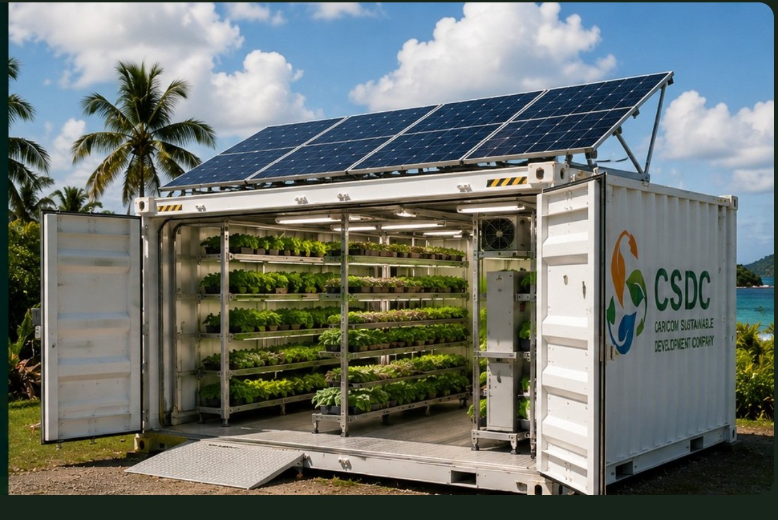
Container Farms for Caribbean Food Security
Automated, climate controlled growing units that produce fresh crops all year on a small land footprint, built for Caribbean conditions.
Controlled environment growing for the region
CSDC is developing closed container farms for the Caribbean. Each unit is a controlled environment growing system that uses less land and water than open field production and is not exposed to weather shocks. Our first pilot site is in [redacted], with a view to a wider regional programme.
Three reasons this matters
Food security
Reduces dependence on imported fresh produce.
Climate resilience
Production that continues through drought, flooding and heat.
Local opportunity
Jobs, training and a platform for young entrepreneurs and researchers.
What We Will Grow, and Why
[redacted] spends about 7.3 billion a year (in local currency) on imported food. Our crop choices target the part of that bill where a climate controlled container can compete: fresh produce that is hard to grow in lowland tropical heat and is largely flown or shipped in today.
Salad greens and temperate leaves
Lettuce, salad mixes, kale and spinach struggle in open field heat, and much of what reaches local shelves is imported. Inside a controlled container they grow to schedule all year, harvested and delivered within hours.
Culinary herbs and chadon beni
Chadon beni is in nearly every local kitchen, yet supply still leans on wild harvest. Cultivated, year round supply gives hotels, restaurants and processors a steadier product, alongside basil, mint and other culinary herbs.
Microgreens
Fast cycle, high value crops for chefs and foodservice buyers, supplied on weekly standing orders.
Hot and seasoning peppers
Scorpion, pimento and seasoning peppers serve local demand, with export potential for diaspora markets as a later upside.
Premium exotics, tested first
Strawberries, blueberries and edible flowers are imported today and are in demand from hotels. We will trial them on a small share of pilot space and expand only if the results justify it, so the core farm never depends on them.
One unit will not replace the import bill, and we do not claim it will. It proves the model: fresh, local, reliable production in the categories where imports dominate, ready to replicate across the Caribbean.
Where the project stands
Accepted into the EGERIES B2B Digital Incubation Programme (Building the Caribbean, Summer 2026 cohort), with IDB Lab involvement.
Other institutional grant funders and sponsors under consideration.
Four steps
- 1
Scope and cost the pilot
A fully costed pilot model covering wages, statutory costs, operating costs, overheads and contingency.
- 2
Secure the site
Land access identified at a site in [redacted].
- 3
Build with partners
Academic, research and funding partners involved while the design is still open.
- 4
Replicate
A model designed to travel across the Caribbean.
Ways to work with us
Academic and research partners
Student venture design, applied research, postgraduate placements and extension training.
Funders and development institutions
A scoped, costed pilot with a clear route to scale.
Government and community partners
Food security, training and local employment.
Let's talk
Interested in partnering on Caribbean container farming? Get in touch.